
Jacob's Last Blessing: The Power of Words | Genesis 48
Nov 09, 2026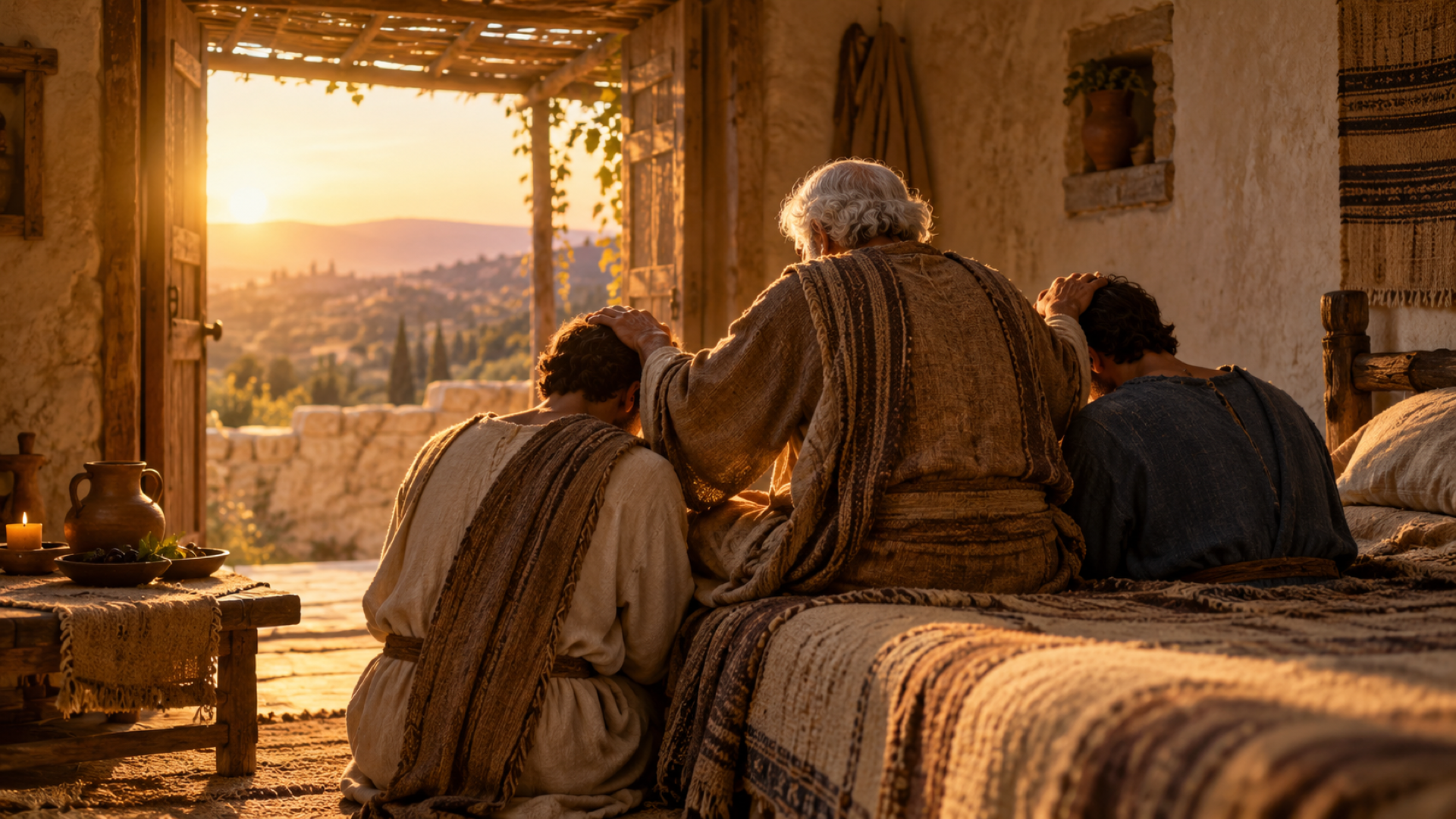
Words spoken over us carry weight. A parent's blessing can speak a hopeful future over a child, while careless words can tell that child to settle for less. In Genesis 48, Jacob's words to Joseph's sons show how a family can speak about the future with confidence in God's care.
What did Jacob's blessing give Joseph's sons?
Jacob made Joseph's sons part of his own family and its inheritance. He told Joseph that Ephraim and Manasseh “are mine; as Reuben and Simeon, they shall be mine” (Genesis 48:5). Joseph's sons were his grandsons, yet Jacob counted them as sons alongside Reuben and Simeon. The family would remember them by Jacob's name.
Jacob's words were not a passing compliment. They changed the place of Ephraim and Manasseh in the family. Later children Joseph might have would be called his own, but these two would be counted with Jacob's sons. The names of Ephraim and Manasseh would carry the future of Joseph's family forward.
Jacob had lived in Egypt with Joseph for seventeen years. As Joseph brought his two sons to him, Jacob asked who they were because his eyes had grown dim with age. Once Joseph identified them, Jacob called them close, kissed them, embraced them, and spoke a blessing over them. His welcome and his words made their place clear.
Words of belonging matter within a family. Children can hear what adults expect of them in the way they speak. Do your words tell them that they are loved and included, or do they keep them at a distance? Jacob's blessing gave Joseph's sons a place in the family God had promised to grow.
What did Jacob speak over the next generation?
Jacob spoke about God's care across his whole life. He spoke these words over the boys: “God, before whom my fathers Abraham and Isaac walked, The God who has fed me all my life long to this day, The Angel who has redeemed me from all evil, Bless the lads; Let my name be named upon them, And the name of my fathers Abraham and Isaac; And let them grow into a multitude in the midst of the earth” (Genesis 48:15-16).
He looked back on a life in which God had fed and redeemed him, then spoke a blessing over the sons who would continue the family. Their future was connected to God's promise to Abraham, Isaac, and Jacob. Jacob was not looking only at the moment in front of him. He spoke about a family growing into a multitude.
The words of the blessing came from the history Jacob had lived with God. He spoke of God's care “all my life long,” not merely in one season. That is a steady place for a family to stand. Circumstances can change, but God's faithfulness does not depend on everything being settled in the present.
When you speak to the people you love, what do they hear about God and their future? Jacob's example gives a family words rooted in God's care and promise. Even as he neared death in Egypt, he still believed that what God had promised was coming to pass.
Why did Jacob cross his hands?
Jacob deliberately gave Ephraim, the younger brother, the greater blessing. Joseph had positioned the boys so Jacob's right hand would rest on Manasseh, the firstborn. Jacob crossed his hands and placed his right hand on Ephraim instead. Joseph tried to correct him, but Jacob knew which boy was which.
Jacob answered Joseph, “I know, my son, I know. He also shall become a people, and he also shall be great; but truly his younger brother shall be greater than he, and his descendants shall become a multitude of nations” (Genesis 48:19). Manasseh would also become a people and be great. Jacob's words did not dismiss him. He recognized both sons and named the greater blessing for Ephraim.
The order people expect did not decide the outcome. This echoed Jacob's own story: he was the younger twin, yet he received preeminence over Esau. Later, Ephraim's tribe was counted at 40,500 men able to go to war, while Manasseh's was counted at 32,200 (Numbers 1:32-35). Those figures count men able to go to war, not women, children, or older men. Still, Ephraim's number in the census was larger.
God looks beyond outward appearance. “For the LORD does not see as man sees; for man looks at the outward appearance, but the LORD looks at the heart” (1 Samuel 16:7). A person's natural ability or place in a family does not tell the whole story of what God can do. First Corinthians 1:26-29 also speaks of God choosing what the world considers weak, base, despised, and insignificant. You do not have to measure your future by someone else's ranking.
How can you stop repeating words that limit you?
Words have weight. Proverbs 18:21 says, “Death and life are in the power of the tongue, And those who love it will eat its fruit.” A teacher once told a young Black student, “People like you can never be like that,” and, “You need to settle for something less.” The account shows how spoken words can become a curse instead of a blessing.
Other people's words are not the only ones that can hold us back. We can repeat failure to ourselves after a mistake, or treat one disappointment as proof that nothing ever works for us. Imagine washing your car after two weeks without rain, then saying the rain will come because things always go wrong. That way of speaking turns a familiar inconvenience into a verdict about your whole life.
You can choose to stop cursing yourself with words of hopelessness. A mistake does not have to become the story you tell about everything you do. Speak with care about your life and about the people in your family. The words you use can agree with failure, or they can agree with what God has promised.
Jacob's attempt to secure Isaac's blessing through deception was wrong. Later, God gave Jacob the blessing at Bethel. Words spoken over a life carry weight, and God's promise stands.
What can you trust when your future is unfinished?
Jacob spoke confidently about God's promise while he was still in Egypt. He told Joseph, “Behold, I am dying, but God will be with you and bring you back to the land of your fathers” (Genesis 48:21). Jacob expected to die outside the land, yet he trusted that God would bring his family back. His circumstances did not cancel what God had promised.
That confidence shaped what he could say to Joseph. Jacob's life was nearly over, but God's promise continued beyond it. The blessing of Ephraim and Manasseh, his words about Joseph, and his confidence in the return all pointed toward a future Jacob would not see for himself.
You may not see how every promise will unfold. You can still speak from what God has shown Himself to be: the One who fed Jacob all his life and who would be with Joseph after Jacob's death. As Jacob faced death in Egypt, he told Joseph that God would bring him back to the land of his fathers.
Go deeper: watch Through the Bible: Genesis 48 on YouTube.
Discover Your Calling
Andrew Wommack is hosting a free 4-day Masterclass to help you find clarity, direction, and confidence in what God has for your life.
